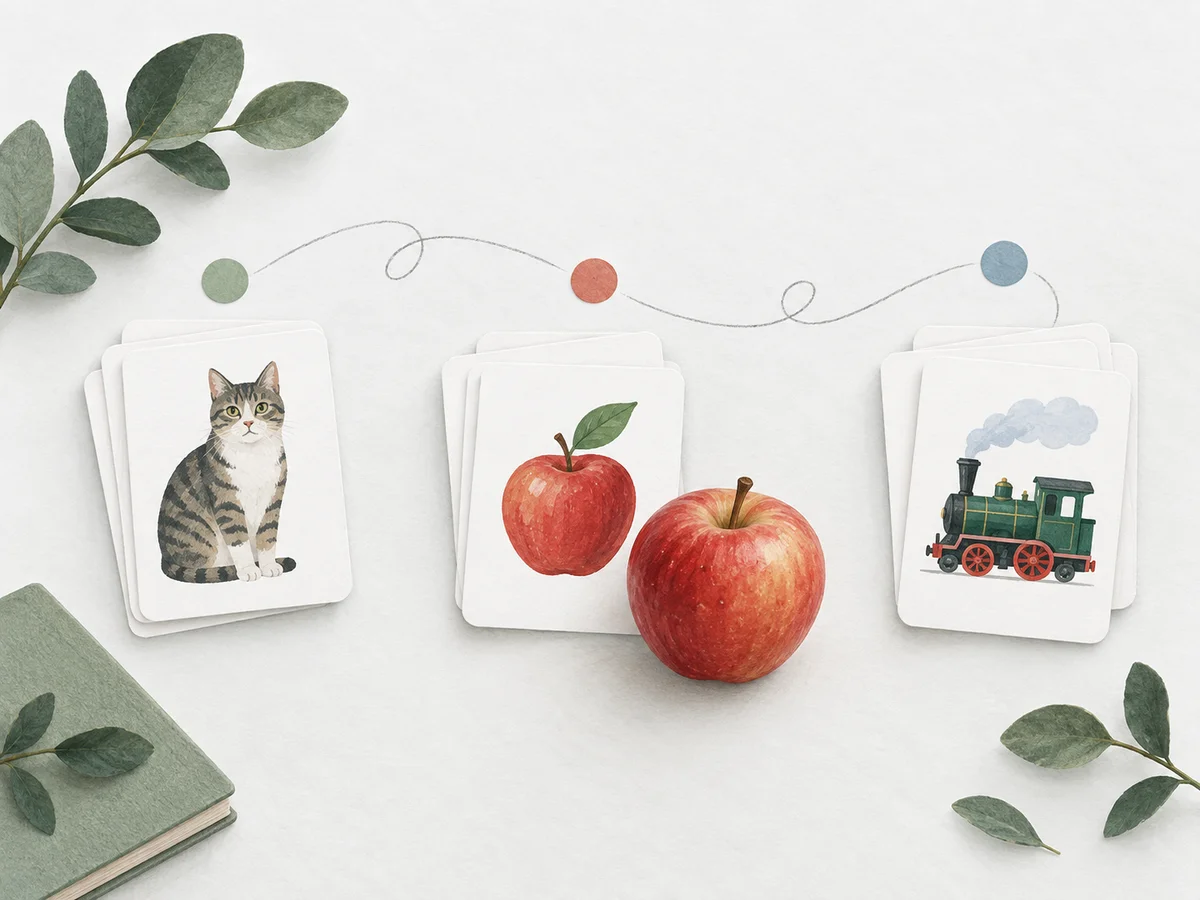
A learner can name a cat on a card today and struggle to remember the word tomorrow. Another can recognise the same illustration every time, but not a different cat in a photograph. Both situations expose the gap between getting through a stack of cards and learning something you can use.
Flashcards can help, but the method matters more than the card. The strongest evidence concerns two things you do with them: trying to retrieve an answer from memory, and returning to it after a delay. Looking at a picture, reading its label, and moving on is a different activity.
This guide explains what those findings mean for studying and vocabulary practice, where the evidence stops, and how to use picture flashcards without turning learning into a test of endurance.
Are flashcards effective? Start with the learning method
A flashcard is a prompt: a word, picture, question, or problem paired with information you want to learn. It can support useful practice, or simply give you another way to reread something.
In a 2013 review of ten learning techniques, Dunlosky and colleagues rated practice testing and distributed practice as having high utility. That supports retrieving information and spacing practice, not a finding that every flashcard app or picture deck works equally well.
A 2021 meta-analysis of classroom quizzing brought together 222 independent studies involving 48,478 students. It found an average benefit for academic achievement, with outcomes varying by factors such as feedback and the comparison activity. These were classroom studies, not a trial of Tevuki or a guarantee about a particular child.
The useful question is therefore not just “Do flashcards work?” It is “What does the learner actually do before seeing the answer?”
Active recall: answer before you check
Retrieval practice, often called active recall, means trying to bring information to mind rather than looking at it again.
For an adult studying vocabulary, that might mean producing a translation before turning over a card. For a child learning picture labels, it might mean naming an animal before hearing the recorded word. The task needs to match something the learner can already attempt; a new word must first be taught.
In a 2008 vocabulary-learning experiment, Karpicke and Roediger compared what happened after students had first recalled a word correctly. Continuing to practise retrieval improved later recall; continuing to study the word without further retrieval did not produce the same benefit. One successful answer was not the end of learning.
This does not mean “make every question harder.” An impossible prompt produces frustration, not useful practice. Offer a model or a hint when needed, then return to an achievable attempt later. Check the answer so you practise the correct information rather than rehearse a mistake.
Spaced repetition: come back after a gap
Spaced repetition means revisiting material across separate occasions instead of concentrating all the practice into one sitting.
Cepeda and colleagues’ 2006 meta-analysis of verbal recall examined 317 experiments. The spacing interval and the length of time until the final test worked together: intervals associated with the best recall grew as the intended retention period grew.
That is more nuanced than “review exactly when you are about to forget.” You cannot observe that moment directly, and there is no universal timetable for every word, learner, and goal.
For a small picture vocabulary set, one starting routine is to teach a few words, revisit them on another day, and check again later in the week. That is a practical example, not a research-validated schedule for your child. Shorten the gap or add support if the words are consistently inaccessible; extend it gradually when recall is reliable. You can organise this with paper cards and a simple note. An algorithm is not required.
What do we know about children learning words?
Research with university students does not automatically tell us how to teach a preschooler. There is more relevant evidence, but it still needs careful interpretation.
In a 2020 review of four word-learning experiments, Leonard and Deevy described benefits of repeated spaced retrieval for preschool children with specific language impairment and their typically developing peers. Benefits included recalling word forms and meanings, and applying words to new pictures. The tasks involved deliberately taught novel vocabulary under experimental conditions.
A 2024 study compared expanding and equally spaced retrieval schedules in 14 children with developmental language disorder and 14 peers. The expanding schedule helped early retrieval, but the conditions were similar at final testing. A more elaborate schedule was not automatically better.
These findings support investigating how retrieval can help word learning. They do not establish that a commercially available deck treats a language disorder, or that more repetitions are always beneficial.
Picture flashcards: recognising a card is not the whole goal
If the goal is understanding “apple,” identifying one particular drawing is only a start. Can the learner recognise another apple? Find one in the kitchen? Understand the word without the familiar card?
Research on learning from picture books illustrates why transfer deserves attention. In that study, the examples and their arrangement affected how children of different ages generalised and transferred a concept. It concerned camouflage in picture books, not vocabulary flashcards; the practical connection is an inference, not direct proof of a flashcard method.
For everyday vocabulary, deliberately connect a card with photographs, objects, actions, and conversation. Show an apple card, then look at a real apple together. For “open,” demonstrate the action with a door or a box. Check understanding in those settings instead of counting only correct card responses.
How to study with flashcards: a manageable routine
- Choose a small, useful set. Start with words or ideas the learner has a reason to use, rather than rushing through a large deck.
- Teach before checking. Show the picture, name or explain it, and connect it with something familiar.
- Separate the prompt from the answer. Cover a printed label or a visible on-screen word. Invite an achievable response before revealing the label or playing the audio.
- Check and support. Confirm the answer or offer a clear model. If repeated attempts are unsuccessful, reduce the demand rather than extending the quiz.
- Return on another occasion. Note which prompts need support, and revisit them after a gap. Check previously successful items too.
- Try another example. Use a different picture, an object, or a real situation to see whether the knowledge extends beyond the original card.
This routine applies research principles; it is not a tested Tevuki intervention. Reading, conversation, play, and practice in context still have jobs a stack of flashcards cannot do.
What about flashcards for autistic learners?
There is no single flashcard method for all autistic people. Age, language, interests, sensory preferences, and communication needs differ. The studies above do not establish the effectiveness of Tevuki for autistic learners.
Treat picture cards as optional learning materials, not as autism treatment or a replacement for communication support. A person can respond through speech, pointing, sign, or their usual communication system; those responses involve different demands and are not identical measures of recall. Do not require spoken answers or eye contact to count participation.
If an activity is distressing or disconnected from a useful goal, change it or stop. Where a family is working with a speech-language professional or educator, choose cards around the person’s existing goals rather than adding a separate drill.
Try free picture flashcards, with clear expectations
Tevuki’s public flashcards provide illustrated words, audio in four languages, and printable PDFs without an account. Sets include Animals, Transport, Emotions, and Daily Routines. You can also download a printable animal set.
The public catalog does not automatically schedule spaced reviews, assess answers, or track concept-level mastery. You or the learner organise the practice. The research supports principles you can use with the materials; it is not evidence that Tevuki itself has been clinically or experimentally validated.
The aim is not to finish every card. It is to find out whether a small amount of useful knowledge can be remembered later and used somewhere else.
Research and further reading
- Dunlosky et al. (2013): Improving Students’ Learning With Effective Learning Techniques. Review of ten study techniques.
- Karpicke and Roediger (2008): The Critical Importance of Retrieval for Learning. Vocabulary experiment comparing repeated study and retrieval.
- Cepeda et al. (2006): Distributed Practice in Verbal Recall Tasks. Meta-analysis of spacing and retention intervals.
- Yang et al. (2021): Testing (Quizzing) Boosts Classroom Learning. Meta-analysis of classroom studies.
- Leonard and Deevy (2020): Retrieval Practice and Word Learning in Children. Review of preschool word-learning experiments.
- Leonard et al. (2024): Does Expanding Retrieval Provide Additional Benefit?. Comparison of two retrieval schedules.
- Strouse and Ganea (2021): The Effect of Object Similarity and Alignment of Examples on Children’s Learning and Transfer From Picture Books. Research on generalisation and transfer, not a flashcard trial.