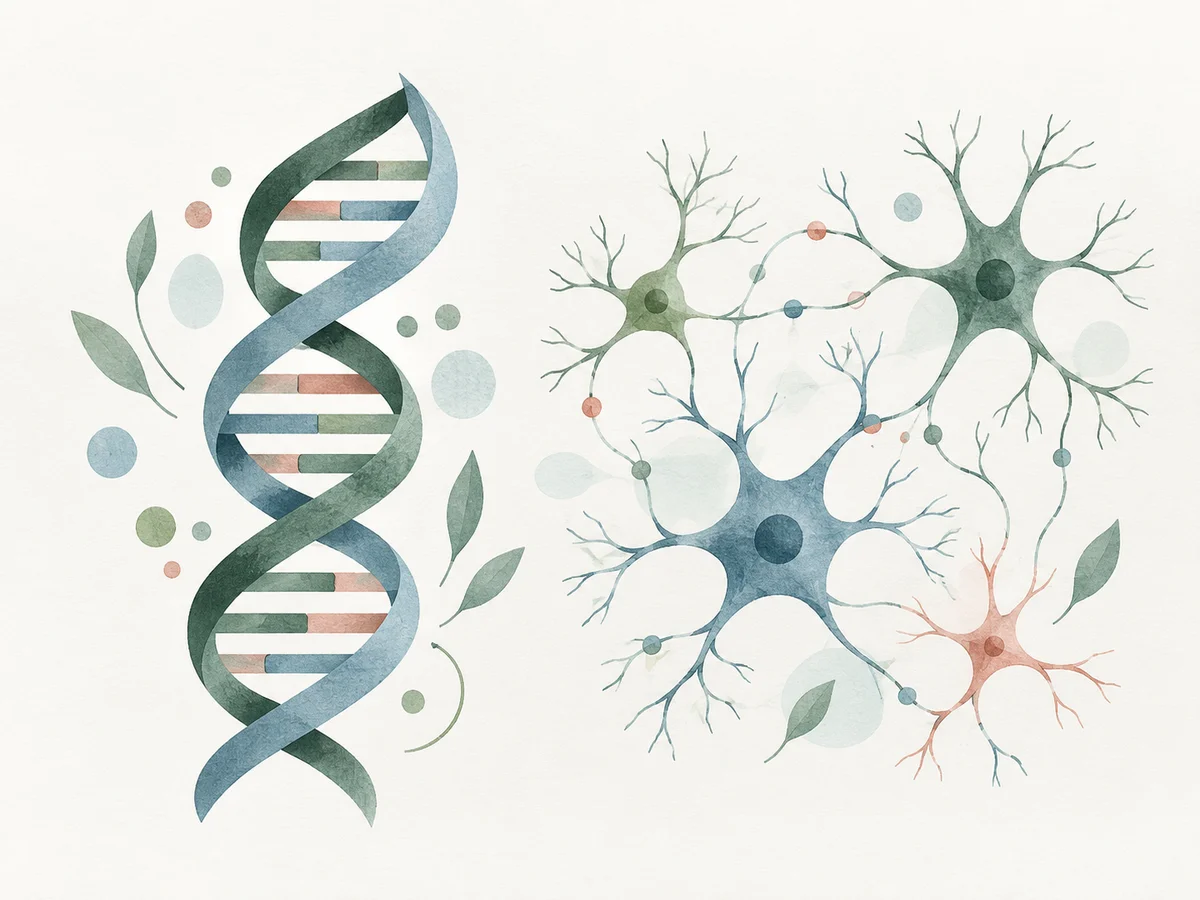
There is no single cause of autism that explains every autistic person. Genetics contributes substantially, and researchers are studying how genetic differences and non-genetic factors affect early development. For most people, science cannot identify one event or exposure that explains why they are autistic. NICHD
Vaccines do not cause autism. Parenting style does not cause autism. Other claims, including those about screen time or acetaminophen during pregnancy, need a careful distinction between an association and evidence of a cause.
What researchers know
Autism is a neurodevelopmental condition. It involves differences in social communication and interaction, alongside restricted or repetitive patterns of behavior or interests. Autistic people vary in their abilities, difficulties, and support needs. Although signs often emerge in early childhood, a person can receive a diagnosis at any age. NIMH
There is no single “autism gene.” Many common genetic variants each contribute a small amount to the likelihood of being autistic. Some rarer changes have larger effects. Having a variant associated with autism does not automatically mean someone will be autistic. MedlinePlus Genetics
Genetic changes can be inherited or arise for the first time in a child, even when neither parent has that change. Large genomic studies have found both kinds. A family can therefore have an autistic child without either parent being autistic. Trost and colleagues, Cell, 2022
Researchers also study non-genetic factors. Older parental age, complications around birth, and some prenatal exposures have been associated with a higher likelihood of autism. Here, “environmental” includes biological conditions and exposures before birth; it does not mean parenting. These associations cannot tell a particular family what caused their child’s autism. NIEHS
A risk factor is not an explanation for one person
An association means two things occur together more often than expected. Establishing a cause takes more work. Researchers need to consider other explanations, such as family genetics, the reason someone took a medicine, or differences in how people were assessed.
An exposure can come before a diagnosis without causing it. A diagnosis records when autism was recognized, which may be years after developmental differences first appeared. A percentage increase reported in a study also describes a group, not a verdict about an individual.
Common myths about what causes autism
“Vaccines cause autism”
Vaccines do not cause autism. In December 2025, the World Health Organization’s vaccine-safety experts reaffirmed this conclusion after reviewing evidence that included 31 primary studies published between 2010 and August 2025. Their review covered vaccines containing thiomersal as well as vaccines more generally. Unanswered questions about autism’s biology do not make the vaccine claim an open question. WHO
“Bad parenting causes autism”
Parenting style, upbringing, and social circumstances do not cause autism. Claims that an emotionally distant parent makes a child autistic are unsupported. Families can work on communication and daily support without accepting blame for the condition. Chelsea and Westminster Hospital NHS Foundation Trust
“Screen time is a proven cause”
Current research does not establish that screen time causes autism. A systematic review covering 30 studies found an association between preschool screen exposure and autism diagnoses, but the authors rated the evidence as very low certainty. Yuan and colleagues
Much of this research is observational. Family circumstances or existing developmental differences may affect screen use. A separate meta-analysis discussed the possibility that autistic children may be more drawn to screens, rather than screens causing autism. This does not settle every question about screen use and development; it does rule out presenting these studies as proof of “screen-induced autism.” Ophir and colleagues, 2023
“Taking Tylenol during pregnancy causes autism”
Acetaminophen, also called paracetamol and sold under brands including Tylenol, has been studied extensively. Some observational studies have reported associations with later autism diagnoses. That does not establish that the medicine caused autism.
A 2024 Swedish study followed about 2.48 million children. A small association in the population analysis disappeared when researchers compared siblings, a method that accounts for some shared family factors. The authors found no association with autism in those sibling comparisons. This strengthens the case for confounding, although one research design cannot prove that every possible risk is zero. Ahlqvist and colleagues, JAMA, 2024
An umbrella review published online in September 2026 likewise concluded that the available epidemiological evidence did not provide convincing support for a causal relationship. Its results were sensitive to study quality and analytical choices. Tayebi-Hillali and colleagues, 2026
In September 2025, the FDA announced action over a possible association, while explicitly acknowledging that causation had not been established. ACOG’s advisory said the available evidence did not justify changing clinical practice. A warning about a possible association should not be rewritten as a proven cause. Questions about medication during pregnancy belong in a conversation with a clinician who knows the person’s circumstances. FDA, ACOG
What remains uncertain
Researchers still cannot fully explain how different genetic changes produce such varied developmental outcomes, or which combinations of genetic and non-genetic factors matter most. Identifying an association is often easier than working out the biological mechanism behind it. NICHD
For an individual, a genetic finding may explain part of the picture; many people will not receive a specific causal explanation. That uncertainty is a limit of current knowledge. It does not support substituting a confident story about a vaccine, a parent’s behavior, or one ordinary decision during pregnancy.
If you are seeking an assessment for yourself or someone you care for, bring concrete examples of communication, sensory experiences, daily difficulties, and developmental history to a qualified professional. Support can be tailored to a person’s needs without first identifying an exact cause. NIMH
This article provides general information, not an individual diagnosis or medical advice. Sources checked on October 4, 2026.